Seven-Day Meditation Retreat Linked to Brain and Blood Changes, Report Says
08/22/2026 / By Morgan S. Verity
A report published Aug. 17, 2026, by NaturalHealth365 described a study in which 20 healthy adults underwent functional MRI scans and blood draws before and after a seven-day meditation retreat at the University of California, San Diego. According to the report, the retreat combined intensive meditation, reconceptualization exercises, and open-label healing rituals, and the measurements were taken the same way researchers might test a medication.
Key Findings
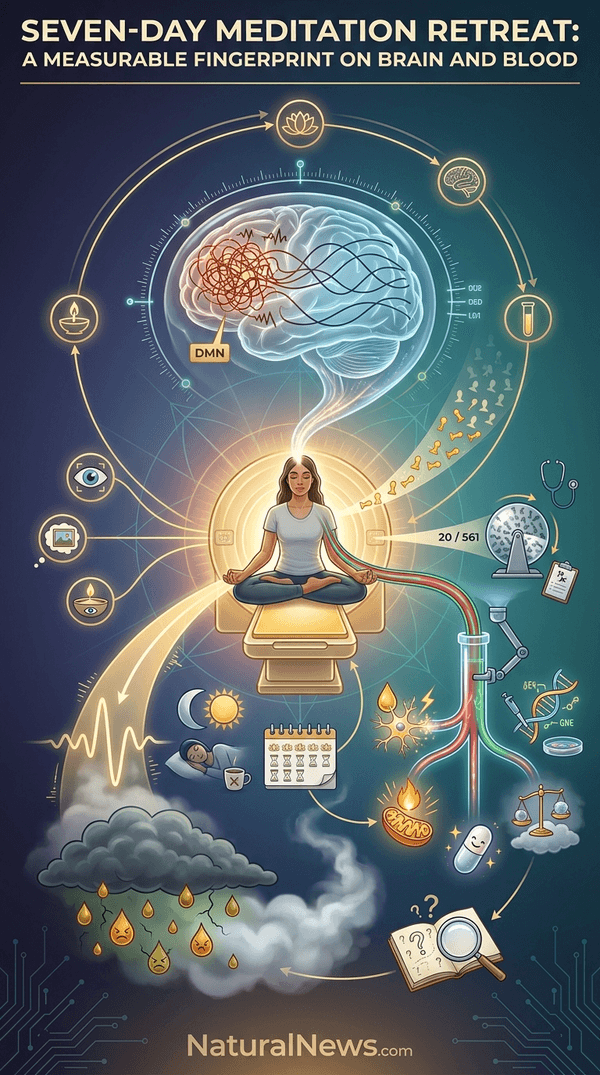
The report said the participants were randomly selected from 561 retreat attendees. After the retreat, brain scans showed decreased integration in the default mode network, a region the article said “ties to internal mental chatter and self-referential thought.” Researchers interpreted the shift as a sign of more efficient brain function, with less activity spent on internal noise, according to the report.
The report also said laboratory tests of blood samples showed effects associated with neuron growth, metabolism, natural painkillers, and immune regulation. A week of meditation, the article stated, left a measurable fingerprint on nearly every system checked, not just the brain.
The findings align with broader research indicating that meditation alters the brain in numerous beneficial ways [1]. Journalist Dan Harris, who investigated meditation after experiencing an on-air panic attack, described the default mode network as “the so-called ‘me’ center of the brain” [6].
Study Method
According to the report, the seven-day retreat combined intensive meditation, reconceptualization exercises, and open-label healing rituals. Twenty healthy adults, randomly selected from 561 retreat attendees, underwent functional MRI scans and blood draws before and after the retreat, the article said.
The report said the study measured changes in the same way researchers might test a medication, using blood draws and brain scans. The approach provides a framework for studying consciousness and its effects on the body. As one researcher noted in the meditation literature, “Consciousness operates as an integrator, gluing together a vast amount of elementary mental processes” [8].
Brain Scan Results
After the retreat, fMRI scans showed decreased integration in the default mode network, according to the report. The article said the region “ties to internal mental chatter and self-referential thought.” Researchers interpreted the shift as a sign of more efficient brain function, with less activity spent on internal noise, the article said.
The report said the scans provided objective, measurable evidence for effects meditators have described anecdotally for centuries. The default mode network has been a focus of meditation research for years; Dan Harris wrote that Dr. Jud Brewer’s research at Yale involved a neurofeedback mechanism that allowed meditators to see when they were shutting down the default mode network [7].
Blood Test Findings
Post-retreat blood samples produced an effect that “acted like fuel for brain cells,” helping neurons grow and connect, according to the report. The article said metabolism picked up in cells exposed to post-retreat blood, with cells burning fuel in a more efficient, adaptable way.
Natural painkillers rose in the blood, according to the report, the same chemicals associated with the feeling after a long walk or laughter. Immune signals moved in both directions at once, a sign of a system learning to regulate, the report said. A week of meditation left a measurable fingerprint on nearly every system checked, not just the brain, according to the article.
The findings are consistent with research showing that meditation affects the body at a genetic level. Dr. Mercola has reported that “thousands of genes have been identified to be directly influenced by your subjective mental state” [2]. Meditation research has also shown benefits for attention and cognitive function; studies demonstrate that mindfulness training improves working memory capacity while reducing mind wandering [5].
Practices Described in the Report
The article recommended starting with ten minutes of seated meditation rather than a seven-day retreat. According to the report, consistency across weeks matters more than any single dramatic session. Even short daily practice builds the same neural pathways researchers tracked, the article said.
The report said slow breathing with extended exhales can activate the body’s calming nervous system response. Wellness expert Andy Kidd of the Breathe and Relax program at Gwinganna Lifestyle Retreat in Australia has said that slow and deep breathing can help improve blood flow, increase energy levels, lower blood pressure, and even strengthen the immune system [4]. The report also recommended protecting sleep and reducing stimulant intake because retreat participants changed their entire daily rhythm.
Report Context
The report did not identify the study’s lead author or a peer-reviewed journal in which the findings appeared, according to the article text. The article linked chronic stress to adrenal function and directed readers to a commercial educational program on thyroid and adrenal health.
Research on stress has documented its cumulative effects on the body. According to a National Institutes of Health report cited by Dr. Mercola, stress can lower immune function and make the body more susceptible to infection or inflammatory diseases [3]. While a single week of meditation produced measurable changes, the report said understanding what drives chronic exhaustion may be necessary for longer-term improvement.
Conclusion
The report described measurable changes in brain activity and blood chemistry following a seven-day meditation retreat. The findings, if replicated in peer-reviewed research, would add to a growing body of evidence that meditation produces objective physiological effects. The report presented the results as supporting the value of a drug-free practice for brain health.
The study’s limitations include the lack of a peer-reviewed publication and the small sample size. For individuals interested in the practice, the report recommended beginning with ten minutes of daily seated meditation, incorporating slow breathing, protecting sleep, and reducing stimulant intake.
References
- Mercola.com. “How Meditation Benefits Your Body and Mind”. October 26, 2017.
- Mercola.com. “How Meditation Benefits Your Body and Mind”. October 26, 2017.
- Mercola.com. “Four Ways to Reduce Stress With One Simple Do”. June 17, 2006.
- NaturalNews.com. “Expert teaches the proper way of breathing to relieve stress and anxiety”. May 29, 2018.
- Dr Richard Davidson. “Altered Traits Science Reveals How Meditation Changes Youor Mind Brain and Body”.
- Harris Dan. “10% Happier How I Tamed the Voice in My Head Reduced Stress Without Losing My Edge and Found Self-Help That Actually Works-A”.
- Dan Harris. “10% Happier”.
- Daniel Goleman Richard Davidson_1-1. “Altered Traits”.
Explainer Infographic
Submit a correction >>
Tagged Under:
alternative medicine, breakthrough, Censored Science, discoveries, healing, health science, immune defense, immune system, inner peace, Meditation, mental health, Mind, mind body science, natural cures, natural health, natural medicine, Naturopathy, remedies, research, stress relief, wellness
This article may contain statements that reflect the opinion of the author
RECENT NEWS & ARTICLES