Study Links High Job Stress to Tenfold Higher Odds of Erectile Dysfunction in Young Men
09/15/2026 / By Coco Somers

Young men who report the heaviest job-related stress face roughly ten times the odds of erectile dysfunction (ED) compared with their least-stressed peers, according to a study of 826 full-time working men ages 22 to 40 published in the International Journal of Clinical Practice.
The research, conducted from March 2022 to August 2024 at a hospital urology department in China, found that 54.37% of men in the highest-stress group reported ED, versus 8.21% in the lowest-stress group. After adjusting for age, weight, smoking, and drinking, the highest-stress group had 10.26 times the odds of ED compared with the lowest-stress group, the report stated.
Erectile-function scores, measured on a standard five-question survey scored from 5 to 25, fell from an average of 22.86 in the lowest-stress group to 15.28 in the highest-stress group. As an observational study, the research cannot prove that job stress causes ED, the authors noted. The findings add to a growing body of work on how chronic stress affects male hormonal health – an area of increasing concern as testosterone levels in younger men have been declining for several decades, according to the Alliance for Natural Health [1].
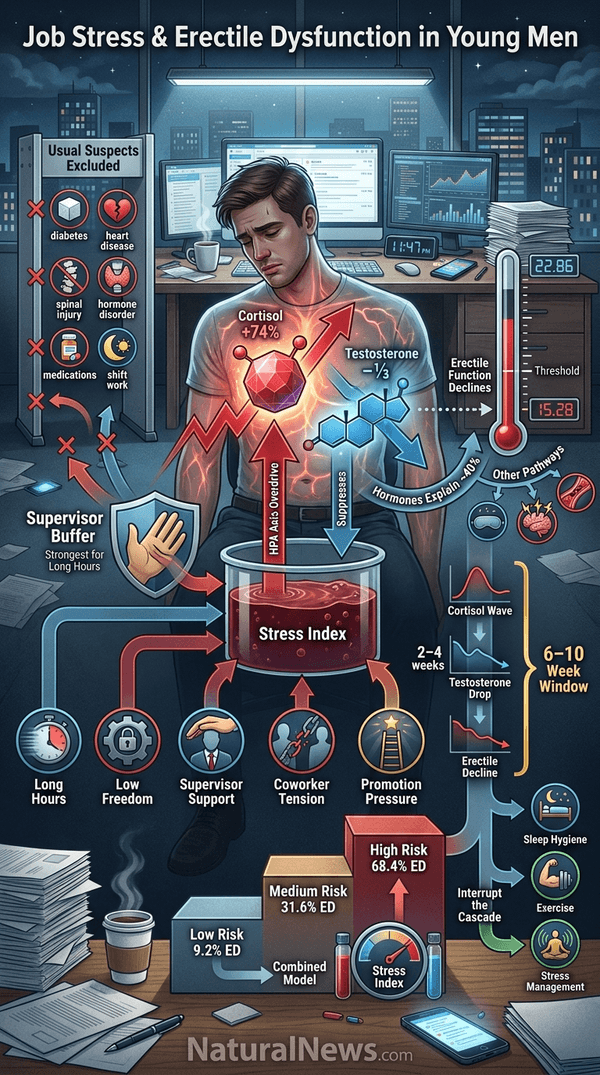
Workplace Psychological Stress Accumulation Index Combined Five Factors
Researchers built the Workplace Psychological Stress Accumulation Index from five factors: weekly work hours, decision-making freedom, supervisor support, coworker relationships and promotion pressure. The combined index predicted ED more accurately than two existing, widely used stress scales, according to the study.
Erectile function was measured with a standard five-question survey used worldwide in men’s health research, with scores ranging from 5, indicating severe dysfunction, to 25, indicating normal function. Participants with diabetes, heart disease, spinal injuries, hormone disorders, medications known to affect sexual function and night or rotating shift work were excluded to rule out other causes.
Participants averaged just over 31 years old. The study authors noted that the index was shaped by a panel of fifteen experts in medicine, psychology and male sexual health. The combined score produced a threshold pattern: erectile-function scores stayed relatively steady at lower stress levels, then dropped more sharply once stress crossed a certain point.
Long working hours emerged as the single biggest factor, with each additional ten hours of work per week tied to a measurable drop in erectile-function scores [2]. The finding aligns with broader research showing that workers in high-stress occupations report elevated stress levels tied to coworker relationships and organizational pressures [3][3].
Morning Cortisol Rose 74% as Testosterone Fell
Blood tests backed up the questionnaire results. Morning cortisol rose by about 74% between the lowest and highest stress groups, while testosterone dropped by more than one-third, the report stated. Cortisol’s normal daily rhythm, which is supposed to peak in the morning and fall by night, also flattened out in the most stressed men, a pattern researchers say points to a stress system running in overdrive around the clock.
Statistical mediation analysis found that hormone changes accounted for close to 40% of the link between workplace stress and erectile trouble, with cortisol contributing the largest share. The remainder likely runs through pathways the hormone tests could not capture.
Supervisor support acted as a buffer, and that protective effect was strongest among men working the longest hours. The study also noted that stress causes inflammation, which in turn is a hallmark of most diseases, from obesity and diabetes to heart disease and cancer [4]. The connection between cortisol and testosterone suppression is consistent with long-standing clinical observations that male sexual function is closely tied to hormonal balance [5].
Modeled Six-to-Ten-Week Intervention Window
The study estimated that cortisol changes appeared two to four weeks before testosterone began dropping, and testosterone decline preceded erectile-function changes by another four to six weeks. The authors describe this as a possible six-to-ten-week intervention window based on statistical modeling, not a proven timeline for any individual man.
Researchers combined the stress index with two hormone measurements into a single model, which identified ED risk more accurately than any single measurement alone. Sorted by risk, men fell into low-, medium- and high-risk groups with ED rates of 9.2%, 31.6% and 68.4% respectively.
The timing data suggests that if stress reduction occurs early enough, it may prevent the hormonal cascade from progressing to ED. Lifestyle interventions such as improved sleep hygiene, regular exercise, and stress-management techniques have shown benefit in reducing stress-related health problems [6][7].
Limitations and Guidance for Patients
The study relied on men recruited from a single hospital urology department in China, so the results may not reflect men in other countries, industries or cultural work environments. As an observational study, it establishes association, not proof of causation, the report stated.
The design captured data at set points in time and estimated hormone and symptom timing through statistical modeling rather than following individual men continuously over months. Thus, the six-to-ten-week window is a modeled estimate, not a directly observed sequence for each participant.
The paper does not report on whether findings would hold for men outside the 22 to 40 age range, for shift workers who were excluded or for men in remote or freelance work arrangements. Anyone experiencing symptoms of erectile dysfunction or concerned about workplace stress should speak with a qualified healthcare provider.
References
- Alliance for Natural Health. “Testosterone levels in younger men have been declining for several decades.” ANH-USA.org. January 06, 2017.
- NaturalNews.com. “Is work making you stressed? Study shows aromatherapy can help.” NaturalNews.com. December 11, 2018.
- B. D. Kirkcaldy and T. Martin. “Among nurses: individual differences.” Journal of Occupational and Environmental Medicine. 2000.
- Mercola.com. “How Chronic Stress Promotes Spread of Cancer.” Mercola.com. March 24, 2016.
- Suzanne Somers. “Bombshell: Explosive Medical Secrets That Will Redefine Aging.”
- Andrew Weil. “Healthy Aging: A Lifelong Guide to Your Well-Being.”
- Mercola.com. “How to Stay Calm Among Chaos.” Mercola.com. June 15, 2017.
Explainer Infographic
Submit a correction >>
Tagged Under:
discoveries, erectile dysfunction, Fertility, health science, hormonal health, men's health, mental health, Mind, mind body science, psychological stress, real investigations, reproductive health, research, workplace stress
This article may contain statements that reflect the opinion of the author
RECENT NEWS & ARTICLES